Showing posts with label film reviews. Show all posts

Tuesday, 5 April 2016

Film Review - When the Wind Blows (Jimmy Murakami, 1986)


Fig 1.When the Wind Blows Poster.

When the Wind Blows is a British animated film about an elderly couple when faced with the possibility of an imminent nuclear strike from the soviet union. It is a disaster film that takes place almost entirely in their home leading up to and after a nuclear strike. The film was made in collaboration with Raymond Briggs and was based on his graphic novel of the same name.

The films overall tone is very serious and increases gradually from beginning to end. There are very few lighthearted moments in the film and a lot of small details that add to the dismal atmosphere. The couples lack of knowledge about the global situation, and of the effects of radiation is one such example. There is a blend of stop-motion and drawn animation (See Fig 2). The house itself is stop-motion and the characters are drawn animation on top. This blend isn't that noticeable and there is a comfortable coherence in the film's style.


Fig 2. Stop-Motion and Drawn Animation.

The lack of high points in this film makes it harder to watch as thing go from bad to worse in the story. While this does make the film seem like a realistic depiction of the situation, it is not very balanced as a film and as such can drag the viewers attention away from the story.

Overall, while there are some minor flaws that can be picked out, the film is impressive is many more ways. It's story is simple and elegant and the animation style fits perfectly with the tone of the story.

Illustration List
Murakami, J (1986) Figure 1. When the Wind Blows Poster. http://www.chud.com/wp-content/uploads/2015/11/When-the-Wind-Blows-Poster.jpg (Accessed on 09/03/16)

Murakami, J (1986) Figure 2. Stop-Motion and Drawn Animation. http://www.chud.com/wp-content/uploads/2015/11/When-the-Wind-Blows-01-600x448.jpg (Accessed on 05/04/16)

Sunday, 6 March 2016

Film Review - Belleville Rendez-vous (Sylvain Chomet, 2003)


Fig 1. Belleville Rendez-vous Poster.

Belleville Rendez-vous (The Triplets of Belleville) is a film about the Tour de France and a boy who grows up and competes in it. During the event however, he is taken hostage and transported to america where he is forced, along with two other riders, to take part in a bizarre cycling based betting game. He is later rescued by his grandmother and dog in a daring escape from the american mob bosses who ran the ring. 

Fig 2. Bodyguard Characters.

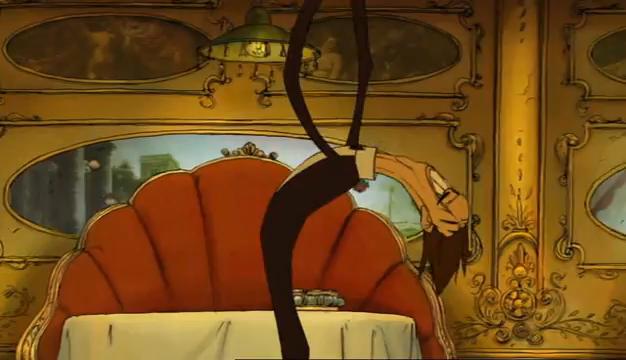
The character design in this film is particularly noteworthy as it takes many of its characters shapes and behavior to their absolute extreme. From the rectangular mob bodyguards (See Fig 2) to the overly bendy waiter, there are many, many characters who have their own unique look and behavior which points directly at their nature. The complete lack of subtlety in the cast makes this film's world feel completely alien. While there are many locations and references in the film that make it feel like this world, the overall skewed style throughout instead turns it into a parallel or a parody.

Fig 3. Waiter Character.

There is almost no dialogue throughout the story, which is an impressive feat as most of the plot is clearly shown to the audience even though that has the potential to be a drawback. Despite this however, there are some smaller details which could be lost to someone viewing this for the first time, the films unique storytelling techniques and visual cues can be tough to get used to if unprepared.

When taking in the entirety of the world this film views, it is so unique and skewed and bizarre that everything from the locations to the characters are intricately detailed caricatures. These come together harmoniously to visualize a curious and in some cases ludicrous reality.

Illustration List
Chomet, S (2003) Figure 1. Belleville Rendez-vous Poster. http://movieposters.2038.net/p/Triplettes-De-Belleville,-Les--Belleville-Rendez-Vous-.jpg (Accessed on 06/03/16)

Chomet, S (2003) Figure 2. Bodyguard Characters. http://byt.wpengine.netdna-cdn.com/wp-content/uploads/2009/02/2776429839_0c67f86ee5.jpg (Accessed on 06/03/16)

Chomet, S (2003) Figure 3. Waiter Character. https://theanimfilmcritic.files.wordpress.com/2012/09/triplets-of-belleville-french-waiter-youtube.jpg (Accessed on 06/03/16)

Saturday, 5 March 2016

Film Review - Persepolis (Marjane Satrapi, 2007)


Fig 1. Persepolis Poster.

The film Persepolis is based upon the autobiographical graphic novel of the same name by Marjane Satrapi. It is about the authors experience growing up in Iran during the Iranian revolution. It is almost entirely in a bold black and white style.

Persepolis covers a great deal of the issues that affected people living in Iran at the time. As the film is from the point of view of the girl growing up, it is particularly effective at telling the story of the Iranian revolution and how those events affect a persons childhood. The story is both fascinating and balanced, there are as many high points as there are lows. There is a great deal of optimism in the telling despite many of the extreme situations that the family went through.

The film keeps the distinct style that came from the graphic novel, and through impressive animation creates a vivid world that pulls the audience into both the brutality of some scenes and the relief and joy in moving moments with the characters.

Illustration List
Satrapi, M (2007) Figure 1. Persepolis Poster. http://kazbah.net/wp-content/uploads/2007/12/persepolis-poster.JPG (Accessed on 04/01/16)

Saturday, 27 February 2016

Film Review - Waltz with Bashir (Ari Folman, 2008)


Fig 1. Waltz with Bashir Poster.

The film follows an Israeli film maker who served as a soldier during the Lebanon War. He has very little memory of his time during the war, as a result asks all of the people who knew him what they remember of him during that time (See Fig 2). Over the course of the film he pieces together his lost memories including one final memory which has bothered him significantly. His key missing memory is of the day of a horrifying massacre that took place in a Palestinian refugee camp.

The animation style of the film is very graphical and similar to the way a graphic novel would be illustrated. As a result it seemed quite bizarre, as the film tackled very serious topics surrounding the Lebanon War, the style would make it seem that these events were otherworldly. The mood created from the sound and loud colours in certain scenes made the entire experience seem completely surreal. It appears as though it is a conscious decision and as such the scenes of the war are extremely compelling and powerful.


Fig 2. Talking with Friend Scene Still.

The film overall moves a fairly slow pace but this makes sense as it is not a story that can be rushed, the pace emphasizes the length of the journey the protagonist goes on to piece his memories back together. It is an effectively told story and without a doubt worth telling.

Illustration List
Folman, A (2008) Figure 1. Waltz with Bashir Poster. http://images.moviepostershop.com/waltz-with-bashir-movie-poster-2008-1020457621.jpg (Accessed on 23/02/16)

Folman, A (2008) Figure 2. Talking with Friend Scene Still. http://www.coffeecoffeeandmorecoffee.com/archives/waltz%20with%20bashir.jpg (Accessed on 27/02/16)

Wednesday, 10 February 2016

Film Review - Sita Sings the Blues (Nina Paley, 2008)


Fig 1. Sita Sings the Blues Poster.

Sita Sings the Blues is a film by Nina Paley and contains two separate stories. One is about Sita and her part in an old Indian legend called 'The Ramayana'. The other is about the artists own life, mainly focusing on her relationship with her husband leading to a break-up. The film draws these two stories together by intersecting them at key points, the two characters of Nina and Sita share moments of joy and sorrow which helps to emphasize the specific similarities in their two separate worlds.

The film has two unique styles of animation within it. Whenever it is telling of the Indian legend it is a very graphic and bold style of 2D animation and whenever it switches to the artists story it is hand drawn and rougher. This is a clever design decision as it is as a result easy to assume that the rougher style is what's real and the cleaner, more graphical style is the legend.


Fig 2. Modern Indian Voice-over.

In his review of the film, Roger Ebert states ''In addition to her characters talking, Paley adds a hilarious level of narration: Three voice-over modern Indians, Desis, ad-libbing as they try to get the story straight. Was Sita wearing jewelry or not? How long was she a prisoner in exile? How did the rescue monkey come into the picture?'' (Ebert, 2009). The addition of a modern voice over adds a much needed level of comedy to the Indian story. There is regular confusion between the multiple voices over the smaller details of the story as they all remember the story differently. These moments with the modern Indians provide breaks from the main narrative for the audience, and are cleverly placed evenly throughout its telling.

Overall the film has many unique and separate parts and pieces, yet it manages to pull it all together in a succinct and vivid story. This makes it a particularly refreshing film and an astonishing achievement for a single individual to accomplish.


Illustration List

Paley, N (2008) Figure 1. Sita Sings the Blues Poster. http://sitasingstheblues.com/SitaEPressKit/SitaPosterAgniA2.png (Accessed on 01/02/16)

Paley, N (2008) Figure 2. Modern Indian Voice-over. http://sitasingstheblues.com/SitaEPressKit/BhavanaSitaContaminated.jpg (Accessed on 10/02/16)

Bibliography

Ebert, R (2009) http://www.rogerebert.com/reviews/sita-sings-the-blues-2009 (Accessed on 10/02/16)

Monday, 25 January 2016

Film Review - Paprika (Satoshi Kon, 2006)


Fig 1. Paprika Film Cover.

The film Paprika, when broken down to its simplest themes, is about dreams and the power they hold over the human mind. The main plot for the film revolves around a new and unfinished technology that is stolen by an unidentified thief. The technology is called the 'DC Mini', a handheld device that allows the user to enter other peoples dreams (See Fig 2).


Fig 2. DC Mini.

Paprika is a complex film due to a number of factors. One in particular is its number of separate character stories. Some of the characters have weak connections to the main plot for a time and seem to be pulled into the larger story simply because of their proximity to it. As such the first half of the film can appear to be a whirlwind of information, that can complicate the viewers understanding if they are not prepared to watch at a faster pace.

This is not necessarily a bad thing however, as all of the main characters have both diverse and interesting stories attached to them. While some parts of the narrative can be somewhat disjointed, this is in some way reflective of the characters own problems when figuring out when they are awake and when they are asleep. The bizarre nature of the narrative is shown well and the style of the animation adds greatly to the experience.

Overall, it is best explained as a peculiar story that is beautifully animated but not without flaws, although many of the flaws are subjective.

★★★

Illustration List
Kon, S (2006) Figure 1. Paprika Film Cover. http://quinlan.it/upload/images/2006/09/paprika-2006-satoshi-kon-poster.jpg (Accessed on 22/01/16)

Kon, S (2006) Figure 2. DC Mini. http://i201.photobucket.com/albums/aa288/reversethieves/show%20images/paprika/Picture1-1.png (Accessed on 25/01/16)

Tuesday, 19 January 2016

Film Review - Mary and Max (Adam Elliot, 2009)

http://www.yourfaceisa.com/wp-content/uploads/2014/11/MaryAndMax.jpg
Fig 1. Mary and Max Poster.

Mary and Max is a true story of two unlikely pen pals, told through stop motion animation. The entire film consists of mostly their letters to each other and how those letters change as they grow older. The film regularly switches between a small town in Australia where Mary lives and an apartment in New York City where Max lives. These two settings are presented in very different ways. New York is shown as  dark and lonely place (See Fig 1), while the Australian town is shown to be a quiet but charming place (See Fig 2).


Fig 2. New York City.

The film uses a lot of clever ideas to make a fairly simple and long winded story very engaging throughout. As it is at its heart, a story about two pen pals an ocean away, reading through letter after letter on either side would get extremely uninteresting after the first few. This issue is fixed with captivating dialogue sequences which appear to make up the majority of the film. As a result it is a truly charming part of the story and the voice actors do very well to capture the emotion in the written words.


Fig 3. Mary's House.

Despite a noticeable chunk of this film being comedic, it is truly chaotic in terms of its emotional changes and overall tone. One minute the film wants the audience to laugh, the next it shows very genuine moments of darkness in these characters lives. It is hard to tell whether this takes away from the experience or makes it all the more potent. One thing is definite however, it is hard to imagine this film telling the story any other way and still creating such a vivid experience.


★★★★☆ 
 

Illustration List
Elliot, A (2009) Figure 1. Mary and Max Poster. http://www.yourfaceisa.com/wp-content/uploads/2014/11/MaryAndMax.jpg (Accessed on 18/01/16)

Elliot, A (2009) Figure 2. New York City. https://blogger.googleusercontent.com/img/b/R29vZ2xl/AVvXsEisGMR-avwRkwbHsC_wdIBo9XWa6cSHVahFpDmYsQd8yI-DEB2u_uOQ2P2yNaiPAW5UvFq9ZhcBl_gVflD2Ni19iSNOXppj9L12V4AacDZO7bkeNXFNLANQj5PYoePKBhZ62hmURw_VIxU/s1600/Mary+and+Max+screenshot+1920x1080+(3).jpg (Accessed on 18/01/16)

Elliot, A (2009) Figure 3. Mary's House. https://blogger.googleusercontent.com/img/b/R29vZ2xl/AVvXsEj4LwBlEr9xWVFjZdytHZqRd1qEDwEw1hSFEADAPBIjkwlE0jslZhp1mgc0RpSmGEn8nrnLMoG2hNBnjMnRotRAW7aqsXVzv69-4bhbFmFMe97cdbhWS1Gy3fWOmf1v6VzHXcjyuK8nih7T/s1600/Mary+and+Max_1.png (Accessed on 18/01/16)

Friday, 8 January 2016

Film review (Comedy) - The IT Crowd Episode 1 (Graham Linehan, 2006)


Fig 1. The IT Crowd Series 1 Cover.

The IT Crowd is a comedy series created by Graham Linehan. It follows the lives of 3 employees who run the IT department for a large business from its basement. As would be expected, the comedy in the series mostly relates to the general public's knowledge of technology. The majority of the comedy in the series comes from purposefully obscure I.T. jokes and bizarre situations that arise due to the strange personalities of the trio themselves.

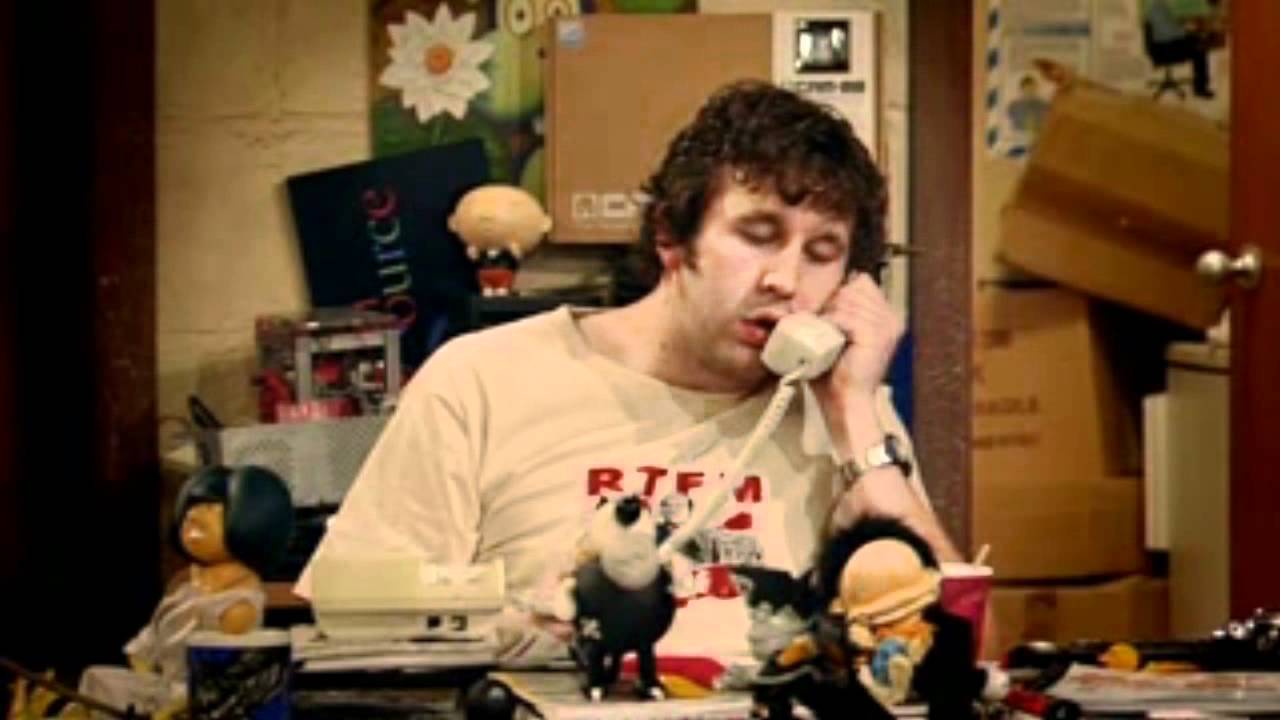
In one particular scene at the very beginning of the first episode involves just one character 'Roy'. He is at his desk procrastinating when the phone on his desk rings. At first he ignores it and carries on eating his food. This goes on for a short time as the phone continues ringing while Roy continuously ignores it and finds other small things to occupy his time. The humor builds on this tension of him not answering the phone. Eventually he sighs and appears to reach directly for the phone when it becomes clear that he is instead reaching for his coffee directly behind his phone. Just when it appears the tension will dissipate it continues to build. This escalates the humor already evident in the scene. After that however, he finally sighs a final time and reaches for the phone itself. Then as if to read the punchline of this joke that has built up, he answers with 'Hello, IT. Have you tried turning it off and on again?'


Fig 2. Series 1 Episode 1 Phone Scene.

The second character of the trio 'Moss' enters the office and sits at his desk near Roy. The phone conversation continues and makes the person on the other side of the phone appear to be terrible with computers. The conversation escalates as Roy gets more and more frustrated with the caller until they have a blown out argument and he slams the phone down. He then turns to his co-worker Moss and says 'That showed her'. The comedy hear comes from the fact that it has only just been revealed that the person Roy was so frustrated with was a woman. The rest of the scene continues from there as the two co-workers start talking.

Illustration List

Linehan, G (2006) Figure 1. The IT Crowd Series 1 Cover. http://nerdcityonline.com/wp-content/uploads/2011/06/theitcrowd.jpg (Accessed on 02/12/15)

Linehan, G (2006) Figure 2. Series 1 Episode 1 Phone Scene. https://i.ytimg.com/vi/YhPejfTQfEA/maxresdefault.jpg (Accessed on 08/01/16)

Wednesday, 2 December 2015

Film Review (Adaptation) - The Hunger Games (Gary Ross, 2012)


Fig 1. The Hunger Games Poster.

The Hunger Games was originally a trilogy of books written by the author Suzanne Collins. The film 'The Hunger Games' was released in 2012 and is an adaptation of the first book in the trilogy. When it was first released it was incredibly successful and set a record for the opening day of a non-sequel. When comparing the film to the book, it appears as though very little has been lost and no key pieces of dialogue have been left out. Overall the film seems to have been made very closely to the narrative in the book. This makes sense as the author of the books, Suzanne Collins was part of the team that wrote the screenplay for the film.

As the film appears very close to the original book, there are no notable or significant changes. Nothing specific has been added either. In terms of bringing the book to a more visual medium and the risks of such a move, the film appears to have captured the mood and look that the book portrays. As a result nothing has been lost in giving the world a specific look.

What is perhaps the most important part of the book are the themes and messages it sends to the reader. It speaks prominently about the problems and exploitation in reality television. The book also has a strong female protagonist which is a rarity in significant works of fiction. The film doesn't lose any of these traits, there are key pieces of dialogue in the books that speak to the audience about reality television. Those are still prominent in the film. The film also keeps a strong female protagonist.

Overall, this film is a rather successful adaptation of the book and there are no notable issues with its representation of the key aspects that are important in the book.

Illustration List

Ross, G (2012) Figure 1. The Hunger Games Poster. http://www.hungergamesdwtc.net/wp-content/uploads/2014/02/The-Hunger-Games-Poster.jpg (Accessed on 01/12/15)

Monday, 16 November 2015

Film Review (Documentary) - Creature Comforts (Nick Park, 1989)


Fig 1. Creature Comforts Poster.

Creature Comforts was originally an animated short film created by Nick Park in 1989. It was a mockumentary that focused on the living conditions of animals in British zoo's. It was created by asking the voice actors specific questions and they would answer them as the animal. The responses given would then be animated using clay animation to create the illusion of the animals giving their opinion on their living conditions.

The animation received widespread acclaim and Nick Park received an 'Academy Award for Best Animated Short Film' for the film in 1990. The film itself is very cleverly constructed. By only including the responses that the animals give without an overarching authors opinion, and also by having many different varied opinions, the film succeeds in raising important questions without any bias. The film throws many issues at the viewer in subtle ways and not a single definitive answer or opinion is given, leaving all of the choice to the viewer.


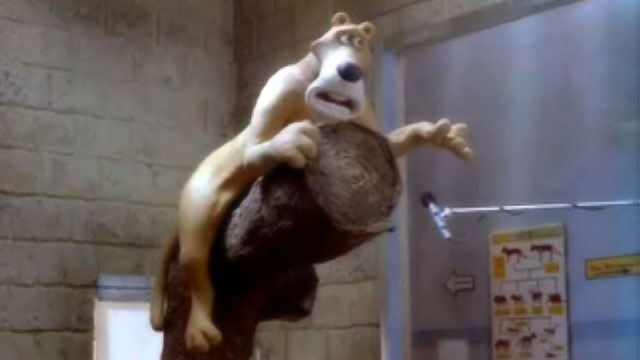
Fig 2. Puma Interview Still.

Despite the fact that this animation is a lot of separate scenes that contain only animals talking, there is never a boring moment. The background is often filled with other animals animated doing strange and out of character actions. For instance, at one point a tortoise headbutts a volleyball on camera which is not commented on at any point afterwards. Moments like these keep the audience interested in the animation itself and not just the audio, which is obviously the focus of the film.

Illustration List
Park, N (1989) Figure 1. Creature Comforts Poster. http://ecx.images-amazon.com/images/I/51WC5AFJT5L.jpg (Accessed on 16/11/15)

Park, N (1989) Figure 2. Puma Interview Still. https://static.shortoftheweek.com/wp-content/uploads/2007/03/creature-comforts.jpg (Accessed on 16/11/15)

Saturday, 7 November 2015

Film Review (Exploitation) - Mad Max Fury Road (George Miller, 2015)


Fig 1. Mad Max Fury Road Poster.

This film begins with Max himself being captured by a group who call themselves 'the war boys' who follow a dictator named Immortan Joe. Max is brought back to a place called the citadel, where Immortan Joe rules over a large population of people. He is used as a blood donor for one of their warriors but once he is taken out onto the road with 'the war boys', he eventually escapes after a battle occurs between them and a woman driving a large oil tanker which has been stolen from Immortan Joe. He manages to catch up to the tanker after the conflict and attempts to take the tanker from her and a group of women she is taking with her. However, shortly after taking the tanker, its engine fails and he is forced let her and the others come with him in exchange for fixing the engine. She introduces herself as Furiosa and tells him that the women she is helping to escape with her are Immortan Joe's wives.


Fig 2. Conflict Scene.

She tells him that they intend to travel far to a place she calls 'the green place'. After a lot more conflicts and problems, they eventually make it to where 'the green place' was supposed to be, only to be welcomed by a group of old women Furiosa knows to be a tribe called the 'Vuvalini'. After discovering that there is no green place there, they all agree to head back to the citadel as they know that there is ample food and water there and it may be possible to take control of it. After a large chaotic final battle, they manage to kill Immortan Joe and the majority of his army of war boys, allowing them to take the citadel with ease. The film finishes with Furiosa and Joe's wives being cheered by the populace of the citadel and Max walking away and fading into the crowd.

The plot for this film is incredibly simple, when broken down it is literally a group moving from point A to point B, then after not finding what they want, moving back to point A. When compared to the original 'Mad Max' film, which is without a doubt an expoitation film. An expoitation film being a film that exploits certain trends and interests that the current audience has. The original 'Mad Max' is a revenge film with a lot of car and bike chases, violence and dangerous stunts. When compared, this latest film has the same simplicity in terms of story and plot, with a lot of exciting conflicts piled on top. As such it would seem that this film is also an exploitation film. It is also seemingly exploiting the same trends that the original film was, which makes sense considering it is part of the same series.

Illustration List

Miller, G (2015) Figure 1. Mad Max Fury Road Poster. http://i.imgur.com/tY3sbBZ.jpg (Accessed on 03/11/15)

Miller, G (2015) Figure 2. Conflict Scene. http://3gem.ca/wp-content/uploads/2015/05/hekhd7g1ddmnboxclncm.jpg (Accessed on 07/11/15)

Monday, 2 November 2015

Film Review (B Movie) - The Devil Bat (Jean Yarbrough, 1940)


Fig 1. The Devil Bat Poster.

The Devil Bat is a film about a scientist who creates perfumes for a company. He feels cheated by the company and the family who runs it as he sold his share in the company before it became hugely successful. He mutates bats and uses them to seek revenge on the family using an aftershave that the bats are attracted to. After the news of mysterious deaths reaches the press, they send a couple of reporters out to the area to investigate and get a story for the newspaper. After many family members are murdered by the bats, one of the reporters comes to the realization that the doctor is the killer and the aftershave is luring the bats. He convinces the doctor to accompany him out to the family's manor, where, when they are sitting outside, the reporter splashes the doctor with his own aftershave. Shortly after, one of his mutated bats appears and kills him.

There are a few key factors in this film that make it stand out as a B-movie. The first and perhaps the most obvious, is the 'Devil Bat' monster. It isn't particularly convincing as a living creature when shown up close and its actions are clumsy and simple. The character of the doctor has what appears to be a Transylvanian accent, which is very poorly executed and takes away from the experience of the film. The story itself is also very predictable and simple, a clever scientist seeks revenge against the family who wronged him and is thwarted by one of his own creations.


Fig 2. The Doctor's Lab.

Despite its obvious flaws, this film does have some redeeming features. The 'Devil Bat' itself may not be convincing close up but it is readable as a bat at a distance. The scenes have clearly been worked with thoroughly to make sure you never get a clear shot of the bat in motion, this does assist in the illusion that the strange flying creature is in fact some kind of monster. To their credit it is only when the bat is stationary in the lab that it be not look very natural, additionally, footage of a real bat is used when they want a close-up of the creature.

The story may be short and ultimately unimaginative, but it also doesn't waste time with scenes that don't correlate with the story and have no relevance. It has a running time of just over an hour and in that time, the story doesn't feel rushed or stretched. For what the film is, it does well to play to its strengths and tell a story as best it can.

Illustration List

Yarbrough, J (1940) Figure 1. The Devil Bat Poster. http://images.moviepostershop.com/the-devil-bat-movie-poster-1940-1020250860.jpg (Accessed on 27/10/15)

Yarbrough, J (1940) Figure 2. The Doctor's Lab. http://wrongsideoftheart.com/wp-content/gallery/stills/devil_bat_02.jpg (Accessed on 02/11/15)

Thursday, 22 October 2015

Film Review (Opposing Characters) - Guardians of the Galaxy (James Gunn, 2014)


Fig 1. Guardians of the Galaxy Poster.

The two opposing characters in this film are the protagonist, Peter Quill (also known as Starlord) and the villain, Ronan the Accuser.

The beginning of the film neatly sums up the backstory of Peter Quill. It begins with him witnessing his mother's death in a hospital bed due to a long illness she had. Shortly after this, in his distress, he runs out of the hospital and collapses on the grass outside. A huge spaceship appears above him instantly and beams him up. The film then jumps ahead 26 years to present-day Quill where the main narrative begins to take shape.


Fig 2. Peter Quill (Starlord).

Ronan is introduced not long after, he is revealed as a fanatic of an alien race known as the 'Kree'. He has a twisted sense of morality and as such he is shown to be exceedingly dangerous. Not much is revealed of his backstory apart from stories of his previous exploits, mass killings and murders across the galaxy.

These two characters oppose each other in various ways. At a base level Quill is shown to want to protect whoever he can along the way of his own adventures. Ronan however, wishes nothing more than the complete and total annihilation of a race known as the 'Xandarians'. Peter Quill wants to protect and Ronan the Accuser wants to destroy. In this way their opposing traits are completely clear. Quill is however a more complex character in many ways whereas Ronan's character seems to be limited by his overbearing character values of hatred and fury towards his enemies. The simplicity of the villain in this film makes sense though, as you are of course never meant to feel any sympathy for him.


Fig 3. Ronan the Accuser.

Their differences do span further than what is on the surface. Throughout the film, Quill is shown to be the voice of reason whenever their is a dispute among his allies. He is in many ways, a guide for the others. Ronan is yet again, the complete opposite of this, driving everyone away for his own selfish desires. In some ways these characters are difficult to unpack thoroughly but they do without a doubt mirror each other in almost every way.

Illustration List

Gunn, J (2014) Figure 1. Guardians of the Galaxy Poster. http://6fja9beiwb2o4svf.zippykid.netdna-cdn.com/wp-content/uploads/2014/05/GOTG-A4-Keyart.jpg (Accessed on 19/10/15)

Gunn, J (2014) Figure 2. Peter Quill (Starlord). http://i.ytimg.com/vi/k8ntBdvvQRU/maxresdefault.jpg (Accessed on 22/10/15)

Gunn, J (2014) Figure 3. Ronan the Accuser. http://www.cinemablend.com/images/news_img/69151/Guardians_of_the_Galaxy_69151.jpg (Accessed on 22/10/15)

Sunday, 11 October 2015

Film Review (Plot Structure) - Scott Pilgrim vs. the World (Edgar Wright, 2010)


Fig 1. Scott Pilgrim Poster.

Scott Pilgrim vs the World is an adaptation of the comic series 'Scott Pilgrim' by Bryan Lee O'Malley. In terms of the plot structuring for this film, it appears to follow the classic 3 act structure, with some small differences. These become apparent once the film is broken down into its core stages.

Act 1 consists mostly of an introduction to Scott Pilgrim, his roommate, his sister, his other band members and his current girlfriend. Once the audience is acquainted with all of these characters, Ramona Flowers enters the picture and Scott is immediately infatuated with her. He spends a great deal of time finding out all the information he can about her. After he finds out that she works for an online delivery service, he orders a package from them hoping she will deliver it.

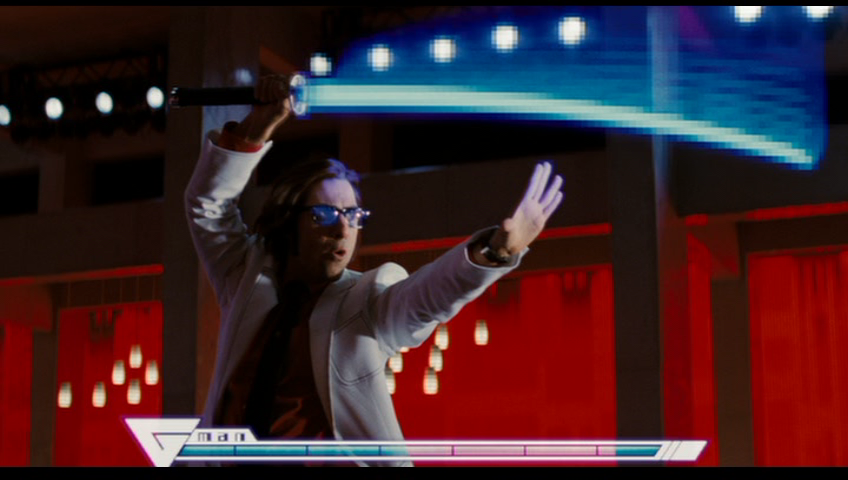
The beginning of act 2 is when he gets Ramona to go on a date with him. This is what sets the rest of the story in motion. Shortly after they start going out, Scott receives an email from his first opponent. He ignores it and deletes the email. Later, at a gig his band is playing, it is disrupted by the very person he received the email from. He introduces himself as Matthew Patel and states that he is Ramona's 'first evil ex'. There is a long battle sequence and Scott is eventually declared the victor. The entirety of act 2 is made up of Scott fighting increasingly stronger 'evil ex's' and finding out more information about Ramona's backstory and the 'league of evil ex's', which is revealed to have been organised by a man called Gideon. His battles with Ramona's previous partners begin to wear on Scott and Ramona's relationship.


Fig 2. Ramona's 1st Evil Ex.

Scott fights 6 'evil ex's' overall and at the conclusion of the 6th he meets with Gideon for the first time. Gideon takes Ramona from Scott. This is the conclusion of act 2 and the start of act 3. Act 3 is solely the preparation for the final battle and the battle itself. After losing Ramona to Gideon, Scott feels compelled to win her back and take down Gideon, he rushes to where he knows Gideon and Ramona will be and confronts him. There is a short battle and Scott declares that he is fighting Gideon to win Ramona back. Shortly afterwards, he loses to Gideon and is killed. The idea is that he lost because he was fighting Gideon for the wrong reasons and as such his resolve faltered.


Fig 3. Gideon, The Final Evil Ex.

In the next scene the hero, Scott, is in a barren desert. This is clearly there to further represent that he did die in the previous scene. He then feels that he has learnt from his mistakes, picks up an extra life that he earned previously in the film and starts again at the beginning of act 3. This time armed with a better understanding of the situation and what he must do, he defeats Gideon and he wins back his love interest, Ramona. With a final scene that ties up loose ends and questions the audience would have, the film concludes neatly.

Scott's resurrection is a literal representation of a key part in the hero's journey This film has used many unique video game tropes to help serve as 'the hero's journey' stages. All of the story after the resurrection could technically be an act 4 on its own as it is a replay of act 3 with better decisions by the hero. These ultimately result in a better ending for the hero.

Illustration List

Wright, E (2010) Figure 1. Scott Pilgrim Poster. http://images.moviepostershop.com/scott-pilgrim-vs-the-world-movie-poster-2010-1020561018.jpg (Accessed on 10/10/15)

Wright, E (2010) Figure 2. Ramona's 1st Evil Ex. http://earnthis.net/wp-content/uploads/2013/09/scottpilgrim3156.jpg (Accessed on 11/10/15)

Wright, E (2010) Figure 3. Gideon, The Final Evil Ex. https://gradingfightscenes.files.wordpress.com/2014/01/picture81.png (Accessed on 11/10/15)

Friday, 9 October 2015

Film Review (Archetypes) - I, Robot (Alex Proyas, 2004)


Fig 1. I, Robot Poster.

I, Robot is set in the near future of 2035 in the American city of Chicago. Del Spooner is a detective for the Chicago police department. He is shown to mistrust robots which is later explained to be because of their cold mathematical thinking process. This hostility began when he was in a car accident along with a young girl, a robot saved Spooner instead of the girl because he had a higher chance of survival. The film follows along a path where detective Spooner's mistrust eventually ends up saving the city from a hostile robot takeover.

The Hero:
Detective Del Spooner is without a doubt the hero of this film. He is at the very centre of the story, a story which revolves around Spooner's hatred towards robot-kind.

The Shadow:
V.I.K.I, the A.I. that controls all of the new NS5 robots turns out to be the shadow at the end of the story. However for most of the story the audience is lead to believe that Lawrence Robertson, the CEO and head of US Robotics, is the shadow. Due to his position of power it is easy to point blame at him and detective Spooner does so with ease. Near the conclusion of the film V.I.K.I is shown to have evolved beyond her programmed duties and turns the newly developed robots against humanity. She believes that she is saving humanity from its own destructive tenancies by removing humanity's free will. She is stopped by Spooner when he injects 'nanites' (a serum designed to destroy the brain functions of robots) into her core at the heart of the US Robotics building.

The Mentor:
The mentor in this film is quite easy to spot. It is Dr Alfred Lanning, the audience is introduced to him after his death at the beginning of the film. A holographic recording of him and old videos guide Spooner towards the answers that Dr Lanning left for him to find.


Fig 2. Dr Lanning Hologram.

The Threshold guardian:
Sonny, the robot created by Dr Lanning seems to be the threshold guardian in this film. It is revealed soon after his appearance that he is different from other robots. He has the same rules and laws inside him that govern the other robots, but he was built to be able to choose whether to follow them or ignore them. Early in the film Detective Spooner interviews this unique machine and this is the threshold. During the interview, Spooner starts to understand that something is wrong, he starts to realise that Dr Lanning is trying to tell him something and that this robot may be the key to solving it.

The Herald:
This would seems to be Dr Lanning. His voice appears occasionally at key moments in the film, narrating the scenes with lines that sound like they are out of a textbook on robotics. His physical appearances in his hologram and in the videos that Detective Spooner watches also seem to narrate the scenes, at least partially.

Shapeshifter:
The shapeshifter appears to be Sonny in this film, at the beginning he is perceived as an enemy. He is immediately suspected by Detective Spooner as the core reason for Dr Lanning's death. Later in the film he begins to earn Spooner's trust and they become allies to stop the robot takeover. In a smaller way however, Lawrence Robertson is the shapeshifter. He is seen to be the villain for the majority of the film, the hero only realizes who the real villain is after they find Robertson dead in his office.


Fig 3. Sonny the Robot.

Trickster:
The trickster in this film is Farber, Detective Spooner's young friend who comes in and out of the storyline throughout. His appearances are always in between key moments, this makes it seem as though he is there only for moving the story forwards. He appears multiple times when the hero is journeying to a certain goal. Farber also provides most of the comedy relief in this film, this mostly comes from trying to impress Spooner and becoming a nuisance or distraction to him.

Allies:
There are three core allies in this film, Dr Lanning's hologram is the first to appear to Spooner, followed closely by Dr Calvin and then shortly afterwards Sonny jumps into the storyline as a perceived villain. Eventually, after trust is gained between Detective Spooner and Sonny, Sonny becomes an ally.

Illustration List

Proyas, A (2004) Figure 1. I, Robot Poster. http://static.dramastyle.com/images/3/8/7115/I,-Robot_7115_1.jpg (Accessed on 07/10/15)

Proyas, A (2004) Figure 2. Dr Lanning Hologram. http://affordablehousinginstitute.org/blogs/us/wp-content/uploads/i_robot_cromwell_inventor.jpg (Accessed on 09/10/15)

Proyas, A (2004) Figure 3. Sonny the Robot. http://d.ibtimes.co.uk/en/full/1367030/sonny-sentient-humanoid-robot-will-smith-film-irobot.jpg (Accessed on 09/10/15)

Monday, 28 September 2015

Film Review (The Hero's Journey) - Harry Potter and the Philosopher's Stone (Chris Columbus, 2001)


Fig 1. Harry Potter Poster.

The majority of the Harry Potter film franchise seems to follow 'The Hero's Journey' framework. At the very least, they use many of the key steps.

The 'call to adventure' and the 'refusal of the call' are intertwined and take place during the majority of the departure/ordinary world stage. Shortly after a teenage Harry is introduced and is living with the Dursleys, he receives a letter from Hogwarts. This is the 'call to adventure'. Uncle Vernon takes the letter from Harry and as a result Harry is sent more letters. A cycle of letters arriving and Uncle Vernon destroying them escalates until he is driven to take the entire family far away where the letters won't find them. Both the burning of the letters and the family moving clearly represent the 'refusal of the call'. The refusal is, curiously enough, not done by the hero himself but by Uncle Vernon instead.


Fig 2. Letters Scene Still.

The 'crossing the threshold' step is particularly intriguing in this film. This is because there are two separate scenes in the film that associate with 'crossing the threshold'. The first happens when Hagrid opens the way into Diagon Alley. The threshold being the divide between our world and the wizarding world.

While this is the first scene that shows this divide, it is by no means the most memorable. Not long after this moment, after Harry has picked up all of his school supplies, he makes his way to a train station in London. This is where one of the biggest scenes in the film takes place. After the audience is introduced to one of the secondary characters, Harry Potter crosses another threshold. He runs at the wall between platforms 9 and 10 and is transported from an ordinary London station to Platform 9 and 3/4. This scene has a real sense of 'crossing the threshold' and it further cements the foundation of this magical world that he is entering.

The rest of the film seems to become a little more complex in terms of finding specific stages and their relevant scenes. There are a few specific scenes that seem to correlate with the steps. The 'belly of the whale' seems like the moment when Harry is being sorted into a house by the sorting hat. He is confronted by the hat, saying that he would do well in slytherin when Harry wants to go anywhere else but slytherin.


Fig 3. Catching the Snitch Scene Still.

The apotheosis step appears to be the moment when Harry catches the snitch and wins the quidditch match for his team. There is a powerful pan-shot that centers around Harry and shows his team and the stands cheering for him. This definitely seems like the moment when Harry is in his element and when he feels god-like.

Overall the film certainly follows many of the key steps in 'The Hero's Journey' but some steps like 'meeting the goddess' and 'woman as temptress' seem without a place in this film.

Illustration List

Columbus, C (2001) Figure 1. Harry Potter Poster. https://kgrantsaboutmovies.files.wordpress.com/2015/06/philostone.jpg (Accessed on 27/09/15)

Columbus, C (2001) Figure 2. Letters Scene Still. http://ulpt0otl4a2om5i54altgpkmw.wpengine.netdna-cdn.com/wp-content/uploads/daniel_radcliffe_richard_griffiths_fiona_shaw_harry_melling_harry_potter_and_the_sorcerers_stone_001.jpg (Accessed on 28/09/15)

Columbus, C (2001) Figure 3. Catching the Snitch Scene Still. http://vignette3.wikia.nocookie.net/harrypotter/images/c/c5/H.P.Snitch.jpg/revision/latest?cb=20110529110920 (Accessed on 28/09/15)

Wednesday, 25 March 2015

Film Review - The Blair Witch Project (Daniel Myrick, 1999)


Fig 1. The Blair Witch Project Poster.

One of this films key strengths is the proximity of the characters to the camera, this means that the audience connects emotionally with the three characters very quickly and effectively (See Fig 2). As such the audience shares in the troubles and traumas that the characters experience. This is of course a crucial element in any horror film. Another thing that this film did very effectively is the way it brought a sense of horror, trauma and even stress into its world. It created horror subtly and steadily increased the intensity of events until the bitter end.


Fig 2. Extreme Close-up Shot.

Roger Ebert states in his review of the film ''The movie is like a celebration of rock-bottom production values--of how it doesn't take bells and whistles to scare us. It's presented in the form of a documentary. We learn from the opening titles that in 1994 three young filmmakers went into a wooded area in search of a legendary witch: "A year later, their footage was found." The film's style and even its production strategy enhance the illusion that it's a real documentary.'' (Ebert, 1999). The power in this film is in its world, this is because it isn't a created world, its the real world. The film is about the filming of a documentary in a real town and about a real legend. Its horror lies in peoples own fears of the woods, the mysterious sounds and the feeling of endlessness seen in every direction. When the characters feel lost, the audience does as well. The film uses sound exceedingly well, almost all of the horror in the night scenes are created out of the panicked voices of the characters and noises with unknown origins. The viewer is regularly faced with complete darkness and unsettling noises, which leaves it up to them to imagine what is happening.

Janet Maslin states in her review ''Five friends who had come out of the University of Central Florida's film program realized that the best way to make a movie without sets, costumes, music or special effects would be to incorporate that spareness into the story. With no easy formulas to fall back on, Daniel Myrick and Eduardo Sanchez (who are jointly credited with writing, directing and editing) give their audiences no easy idea of what to expect.'' (Maslin, 1999). Thanks to a lack of refined scripting before shooting the film, it is not a predictable plot. It is a series of events that regularly jump ahead in time, much like a real documentary. This of course easily lends itself to the films basic plot about the filming of a documentary.

Peter Bradshaw states in his review ''As the three principals, Donahue, Leonard and Williams give sickeningly convincing performances as the three scared, overgrown children, screaming mutual recriminations and descending into inarticulate panic and horror as they realise their deaths are at hand. These improvisations, cajoled from them by the directors, who appear to have effectively sub-contracted to their cast the business of making the film, go beyond a case of "acting themselves". They are as near as dammit being themselves. This film is a vivisectional experiment in anxiety.'' (Bradshaw, 1999). Another element that boosts the film significantly are its characters. The performances they give are disturbingly real, and the camera viewpoint makes the events all the more plausible. That is of course what makes this film so potent in the horror genre, its disturbing realism. It plays on real fears in real environments. Completely believable and horrific events play out and are only logically picked apart after the end of the film when you have caught your breath. Overall, an imaginative, effective and surprisingly gripping experience.

Illustration List

Myrick, D (1999) Figure 1. The Blair Witch Project Poster. http://upload.wikimedia.org/wikipedia/en/2/26/Blair_Witch_Project.jpg (Accessed on 25/03/15)

Myrick, D (1999) Figure 2. Extreme Close-up Shot. http://media.web.britannica.com/eb-media/62/93462-004-46145F2A.jpg (Accessed on 25/03/15)

Bibliography

Bradshaw, P (1999) http://www.theguardian.com/film/1999/oct/22/4 (Accessed on 25/03/15)

Ebert, R (1999) http://www.rogerebert.com/reviews/the-blair-witch-project-1999 (Accessed on 25/03/15)

Maslin, J (1999) http://www.nytimes.com/movie/review?res=9C02E6D91E3CF937A25754C0A96F958260 (Accessed on 25/03/15)

Monday, 23 March 2015

Film Review - Reservoir Dogs (Quentin Tarantino, 1992)


Fig 1. Reservoir Dogs Poster.

A considerable strength within this film is in its storytelling. The story is split-up and mixed around so that the film follows a completely non-linear track. As a result, the audience is constantly faced with past events in strange orders, that don't completely tie in or make sense until the grand finale of the film, which is finally in the present. Usually this would be a risky manouver for any director, but it is done extremely well. Details slowly become known at a steady rate and the audience can keep easily. The story in this film feels just as organic as any linear story.

Roger Ebert states in his review ''The movie feels like it's going to be terrific, but Tarantino's script doesn't have much curiosity about these guys. He has an idea, and trusts the idea to drive the plot. The idea is that the tough guys, except for Tierney and the deranged Madsen, are mostly bluffers. They are not good at handling themselves in desperate situations.'' (Ebert, 1992). The film certainly focuses on the downfall of each of the characters, one by one they are revealed in more detail to the audience and eventually meet their timely end. Using each character to drive the plot works very well in this film, there is a clear focus on specific characters throughout and it feels like they are telling you what happened from their perspective during the job. By interacting with each other through heated debates, the audience is slowly fed information about what happened outside the confines of the warehouse. This certainly made the film more interesting as it does mostly take place in the warehouse (See Fig 2).

Fig 2. Warehouse Still.
 

Anne Bilson states in her review of the film ''while the survivors are trying to work out what went wrong and whether one of them is an undercover cop – the film fills in vital information via an assortment of flashbacks. This is an ambitious structure, but Tarantino pulls it off with panache.'' (Bilson, 2014). The plot consists of a present in the warehouse rendezvous and flashbacks from the characters to fill in key information. As such the audience is regularly faced with the aftermath of something they haven't seen the cause of yet. This is an effective tool and the audience is, as a result, constantly eager to find out what is happening and why. Flashbacks are used extremely well as a plot device in this film.

Jeff Dawson states in his review ''Choosing to concentrate on the aftermath, he veers off instead - within the claustrophobic confines of the hideaway and in the context of Real Time - into psychological drama, with the paranoid hoods recounting their own version of events in a bid to determine just who might be the rat in the house responsible for tipping off the cops.'' (Dawson, s.d.). The character conversations and arguments in the warehouse consist mostly of accusations and suspicions about who the rat might be. This fact is of course left until the bitter end and they are only seeing the rat himself for a short time before the final scene. Before that they treat every character with as much suspicion as they do each other, this is because they know only as much about the individual characters as the characters themselves do about each other. As the scenes in the warehouse mostly consist of endless bickering, the audience doesn't form any real connection to any of the characters. They are treated with an apathetic and curious stare from beginning to end. Overall this film has too many strengths to count and very few weaknesses. An entertaining and shocking experience from titles to credits.


Illustration List

Tarantino, Q (1992) Figure 1. Reservoir Dogs Poster. https://cinefilles.files.wordpress.com/2012/12/reservoir-dogs-poster.jpg (Accessed on 22/03/15)

Tarantino, Q (1992) Figure 2. Warehouse Still. http://www.dvdactive.com/images/reviews/screenshot/2012/1/resdogsbdcap6_original.jpg (Accessed on 23/03/15)

Bibliography

Bilson, A (2014) http://www.telegraph.co.uk/culture/film/filmreviews/11311308/Reservoir-Dogs-review-raw-and-exciting.html (Accessed on 23/03/15)

Dawson, J (s.d.) http://www.empireonline.com/reviews/reviewcomplete.asp?DVDID=6455 (Accessed on 23/03/15)

Ebert, R (1992) http://www.rogerebert.com/reviews/reservoir-dogs-1992 (Accessed on 23/03/15)

Sunday, 8 March 2015

Film Review - Jurassic Park (Steven Spielberg, 1993)


Fig 1. Jurassic Park Poster.

One of the most notable points to make about this film is about the strides it took into early CGI. It was, of course used to create the dinosaurs in the film. Computer generated imagery was certainly needed for the film, as mechanical puppets would have to be worked around. If they had used puppets they would have had to find the right angles with the camera that made it look the most realistic. The camera also wouldn't be able to linger too long on it as the viewer could find its flaws easily given enough time. CGI enabled the film to stand out from the crowd and wow its audiences (See Fig 2 & 3).

Roger Ebert states in his review of the film ''It's clear, seeing this long-awaited project, that Spielberg devoted most of his effort to creating the dinosaurs. The human characters are a ragtag bunch of half-realized, sketched-in personalities, who exist primarily to scream, utter dire warnings, and outwit the monsters.'' (Ebert, 1993). Steven Spielberg clearly knew that the strength of the film was to be found in the quality of the dinosaurs, not the protagonists who stumble around them. That is however, one of the film weak points. With a focus on the visual, the plot and character developments are thinly spread. The plot itself is fairly predictable, it has a steady build-up that the viewer can overtake quite easily. The more you are introduced to the park, the more flaws you can pick out. As Roger Ebert suggests, the characters are far too unrealised and unpolished.


Fig 2. T-Rex Scene Still.

Caroline Westbrook states ''So the script and the performances aren't exactly Oscar material, but it scarcely matters given that the real stars here are the ILM-created dinosaurs, a miracle of modern moviemaking...'' (Westbrook, s.d.). This is another good point about the film, because the dinosaur's are so breath-taking visually, the haphazard character development isn't the focal point of the viewers attention. All eyes are on the dinosaurs. When you do focus on the characters, it is only in the brief moments between the dinosaur appearances. It is certainly something to consider, that this film was produced with a single focus and it worked as a film. It is because that single focus was ahead of the curve at the time of its release.


Fig 3. Jurassic Park Still.

Rebecca Hawkes states in her review ''Those who sneer at the simplicity of the storyline – a basic “don’t mess with nature” parable, during which Grant discovers his latent ability to act as a father figure – are missing the point. Jurassic Park is all about the big emotions: awe and terror, excitement and wonder. It feels very much like a big-screen film, even when watched on TV'' (Hawkes, 2014). There are clearly many sides to the story when it comes to the balance that was struck between the wonder of CGI, and the simplicity of the plot-line. It could be perceived as a mistake to focus so wholly on a single aspect of a film, it could also be perceived as a well thought out and well executed move. When it comes to Rebecca Hawkes review of the film, the simplicity of the plot could simply be the director not wanting to push boundaries he's not comfortable with. To leave the story in a safe place and push harder on the visual aspect. Overall, the visuals are undeniably strong and while the restraints on character development and story are acceptable, they still feel under-worked.

Illustration List

Spielberg, S (1993) Figure 1. Jurassic Park Poster. http://s3-ec.buzzfed.com/static/2014-08/12/12/enhanced/webdr10/enhanced-14020-1407861668-13.jpg (Accessed on 08/03/15)

Spielberg, S (1993) Figure 2. T-Rex Scene Still. http://twitchfilm.com/assets_c/2013/04/jurassic-park-thumb-630xauto-37698.jpg (Accessed on 08/03/15)

Spielberg, S (1993) Figure 3. Jurassic Park Still. http://www.empireonline.com/images/image_index/original/47274.jpg (Accessed on 08/03/15)

Bibliography

Ebert, R (1993) http://www.rogerebert.com/reviews/jurassic-park-1993 (Accessed on 08/03/15)

Hawkes, R (2014) http://www.telegraph.co.uk/culture/film/filmreviews/11310946/jurassic-park-review.html (Accessed on 08/03/15)

Westbrook, C (s.d.) http://www.empireonline.com/reviews/reviewcomplete.asp?FID=4318 (Accessed on 08/03/15)

Saturday, 7 March 2015

Film Review - Jaws (Steven Spielberg, 1975)


Fig 1. Jaws Poster.

Jaws is a film that brought with it a memorable soundtrack, which helped create memorable scenes in the film. Suspense was built up regularly in the film and eventually the viewer associates the soundtrack with an incoming shark attack. This is something the film uses against the viewer on one occasion, when the soundtrack builds up once again and a fin slides into view. The audience expects a scene of violence, right up until the point when the two young boys piloting the fin prop reveal themselves (See Fig 2). This scene plays a trick on the viewer and they are left with an unexpected anticlimax. It is however, only one of the many unforgettable moments in the film.

Fig 2. Jaws Still.

Peter Bradshaw has this to say about the character portrayals in the film ''All have something to prove: Dreyfuss is oceanographer Hooper, a superbly natural, utterly real performance, who has to show he's man enough to take down the big fish. Scheider's police chief has to redeem himself after participating in that contemporary political phenomenon, a cover-up: he withheld information about the shark to protect tourism. And Shaw's grizzled seadog Quint is haunted by a chilling wartime memory.'' (Bradshaw, 2012). The characters are well represented and when you learn of their back-stories it doesn't feel forced. It is minimal and subtle, which works well with this film. As Peter Bradshaw states, the characters are brought across very naturally, which makes for a very real performance which makes this film all the more immersive for the viewer.

Roger Ebert states in his review "Jaws" is a great adventure movie of the kind we don't get very often any more. It's clean-cut adventure, without the gratuitous violence of so many action pictures. It has the necessary amount of blood and guts to work -- but none extra. And it's one hell of a good story, brilliantly told.'' (Ebert, 1975). The premise of the story is utterly simplistic and can be boiled down to a single sentence. A series of shark attacks that leads to three men venturing out on a boat in pursuit of the enormous shark responsible for the attacks. However, the story is well told and you don't realise how simple it is until its over. This film is certainly proof that even with a basic plot, with clever directing and character performances it can become a rich experience for any audience.

In his review, Vincent Canby states ''It's a measure of how the film operates that not once do we feel particular sympathy for any of the shark's victims, or even the mother of one, a woman who has an embarrassingly tearful scene that at one point threatens to bring the film to a halt. This kind of fiction doesn't inspire humane responses. Just the opposite. We sign with relief after each attack, smug in our awareness that it happened to them, not us.'' (Canby, 1975). The lack of sympathy is, at least on a technical level, down to the way the camera operates throughout the attacks. It is usually close-up and fast-paced, never lingering for too long on the poor victim. It is also down to the fact that all of the victims, apart from the last, are unknowns to the audience. They are townsfolk who arent introduced to us for more than a minute before they are in the jaws of the shark. It is clearly an action film because there is no lingering on grief or sadness, in its place there is only adrenaline and suspense. 

Illustration List

 Spielberg, S (1975) Figure 1. Jaws Poster. http://www.panicposters.com/media/catalog/product/cache/1/image/f63dc5ec28f3
175f8a7f615bd217eb71/m/s/msp0007_jaws.jpg (Accessed on 02/03/15)

Spielberg, S (1975) Figure 2. Jaws Still. http://www.gonemovies.com/WWW/Pictures/Pictures/Jaws20.jpg (Accessed on 07/03/15)

Bibliography

Bradshaw, P (2012) http://www.theguardian.com/film/2012/jun/14/jaws-review (Accessed on 03/03/15)

Canby, V (1975) http://www.nytimes.com/1975/06/21/movies/moviesspecial/21JAWS.html?_r=0 (Accessed on 07/03/15)

Ebert, R (1975) http://www.rogerebert.com/reviews/jaws-1975 (Accessed on 07/03/15)